


Water Heater Installation for Greenbelt
The old tank always seems to quit on the coldest morning of the year. We size the replacement to your household, connect it to code, and carry the dead one out, whether you go tank or tankless.
A new water heater has to fit the spot the old one left and connect to the gas line, vent, or circuit already in place. In Greenbelt's older rowhouses and apartment buildings that spot is often a tight closet, laid out long before anyone expected one heater to feed two bathrooms and a dishwasher. We measure the space and check the supply before we talk about models, so the unit we bring is one that will actually go in.
Copying the label off the old tank is the quick way to size a new one, and it is often wrong. We ask how many people shower in the morning, what runs at the same time, and whether the fuel, venting, and space you already have can carry something different.
Sizing the new one to the people using it
A tank that ran fine for a couple can come up short for a family of five, and an oversized tank burns fuel keeping water hot that nobody uses. We work from your actual morning: showers back to back, a load of laundry going, the dishwasher after dinner. Then we lay out the options that fit the space.
- Tank water heaters, the easiest swap where the space and venting already suit one
- Tankless units, with hot water on demand and a smaller footprint, plus gas and venting needs of their own
- Gas, which recovers faster when the supply line and flue can handle the new unit
- Electric, which needs no flue at all and helps in a closet or apartment without venting
When tankless makes sense here
Tankless fits well in a Greenbelt apartment or rowhouse where floor space is the real constraint, as long as the gas line is large enough and there is a clean path for the vent. In some older units neither is true, and a tank becomes the honest recommendation. Whichever way it goes, we show you the reasons.
You get a firm price before anything comes apart. Ask for your free quote, or look at installs we have finished in the project gallery.
The connections that make it safe
Most of what makes a water heater safe happens in the last hour of the install. A gas unit needs a properly sized connector, a shutoff within reach, and a vent that actually draws, so combustion gas goes up the flue and stays out of the room. We check the draft with the burner running before we call the job finished.
Every tank gets a temperature and pressure relief valve, with its discharge pipe run down to a point where a release cannot scald anyone or soak the floor. Where the home has a closed system, an expansion tank goes on the cold side so heated water has somewhere to grow besides that relief valve.
- Gas connection leak-tested before the burner lights
- Vent and draft checked with the unit firing
- Relief valve discharge piped to a safe point
- Expansion tank added where the system calls for one

Out with the old tank, and the space left clean
An old water heater is heavy, often half full of sediment, and sometimes rusted through at the bottom. We drain it, disconnect it, and carry it out of the house ourselves, then haul it away so it never ends up sitting at your curb. The floor gets wiped, the packaging leaves with us, and before we go you get a short walk-through of the shutoff and the temperature setting.
Winter is when this turns urgent. Incoming water runs colder, the heater works harder, and a tank that was already tired picks a January night to give out. If yours is leaking at the base or making no hot water at all, call any hour and we will tell you how soon we can get there.
Done to code so the warranty holds
Water heater replacement is code-sensitive work, and where a permit applies, we pull it. Manufacturers also write installation requirements into their warranties, and a unit put in without the right venting, relief piping, or clearances can lose its coverage before it ever fails. We install to the manufacturer's instructions as well as to code, so if a part does give out early, the warranty is still there for you.
On a swap we also look hard at what the old heater was tied into. Corroded fittings, a missing shutoff on the cold side, or a gas connector that has been bent one time too many get replaced while the water and gas are already off, because that is the easiest moment to do it right.
Brandon carries Master Plumber license PLM40000116 with Maryland, Virginia, and WSSC credentials and a BBB A-rating, and he has been doing this work for close to three decades. If something we installed acts up afterward, one call brings us back to look at it.
Commercial water heaters too
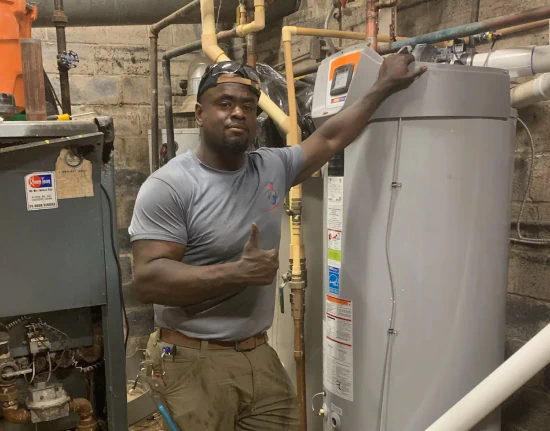
The photo at the top of this page shows Brandon beside a newly installed commercial gas water heater in a boiler room. Apartment buildings, restaurants, and offices around Greenbelt run on units like that, and we size, set, and connect them with the same care. Our commercial system installation page covers the larger building work, or send us the details and we will get right back to you.
Water heater calls across Greenbelt
Our shop sits in Suitland, close enough that getting to a dead water heater in Greenbelt is a quick trip. We work the rest of Prince George's County as well, residential and commercial.
Get a free quoteReviews from people we have worked for
He is a man of his word. He shows up when he says he is coming and he cleans up behind himself.
T. T.Google ReviewsBrandon Jackson is one of the best plumbers I have ever met. He is professional, honest…
Celestine RobinsonGoogle ReviewsTheir service was prompt, professional, and reliable. The pricing was fair, with no hidden fees.
Wesline ReynaGoogle ReviewsBrandon was extremely knowledgeable and professional from the moment he arrived.
M. Owens JonesGoogle ReviewsWater heater questions around Greenbelt
How do I know what size water heater I need?
Start with how many people use hot water at the busiest time of day, which is usually the morning. We look at showers, laundry, and the dishwasher, then at the space and fuel you have. A household that runs out halfway through the second shower usually needs more capacity or a different type.
Should I switch to tankless?
Sometimes. Tankless saves floor space and keeps up with long showers, but it needs a gas line and venting that can carry it, and in some older Greenbelt units that means extra work. We tell you plainly whether it makes sense for your home before you commit to anything.
Is gas or electric better?
If your home already has gas and a working flue, a gas unit usually recovers faster. Electric needs no venting, which helps in an apartment or closet without a flue. Changing fuel types adds work, so we usually recommend staying with what you have unless there is a real reason to switch.
Do you take the old water heater away?
Yes. We drain it, disconnect it, carry it out, and haul it off, so you will never find it waiting at the curb. We also clean the spot where it stood and take every bit of packaging from the new unit with us when we leave.
Will the install keep my manufacturer warranty valid?
We install to the manufacturer’s instructions and to code, including the venting, the relief valve piping, and the required clearances. Those are the details a warranty depends on. Keep your paperwork somewhere safe, and if a part fails early, the coverage is there to use.
Do you install commercial water heaters?
Yes. We install commercial units for apartment buildings, restaurants, and offices, sized to the building’s demand and connected to code. Brandon is a licensed Master Plumber with WSSC credentials, so the work on the incoming service, including any backflow protection it needs, gets done correctly.
My water heater died at night. Can you come?
Yes. We answer 24/7, and a dead water heater in the middle of winter is a call we take seriously. If the tank is leaking, shut off the cold supply to it, then call (202) 840-1998 and we will give you a straight answer on timing.
Cold showers in Greenbelt?
Call Brandon for a heater sized to your home, installed to code, and priced before any work starts, with no hidden fees.