


Pipe Repair for Hyattsville
A water stain on the ceiling rarely sits right under the leak. We track down where the water is really coming from before we cut anything, open only as much wall as the repair needs, and test the pipe before it gets closed back up.
Much of Hyattsville was built long before plastic pipe, and plenty of its houses and apartment buildings still carry metal lines. Plumbing in buildings that age has usually been patched, extended and partly replaced more than once, so the pipe behind a single wall can be three materials from three different decades.
That mix is why we don’t guess. In an older house a leak can run along a joist or down the outside of a pipe for several feet before it shows, and cutting open the ceiling right under the stain often turns up a wet board and no hole. We find the source first.
Tracing the leak before any drywall comes down
We start with the questions that narrow it down. Does the stain grow when one fixture runs, or all the time? Does the water meter creep with every faucet closed? Is it supply water, clean and under pressure, or drain water that only appears after a shower or a load of laundry? From there we follow the pipe routes, check the fixtures above the stain, and test until we can point to one spot. In houses this age, the usual failures are:
- Pinhole leaks in old copper, where the pipe wall has thinned from the inside
- Galvanized joints rusted through at the threads
- Polybutylene supply line, the gray plastic pipe that tends to crack without warning
- Cast iron drain that has rusted through, or a joint where old cast iron meets newer pipe
- Fittings disturbed during a past remodel and never quite sealed
One opening, in the right place
Opening the wrong wall means patching drywall that never needed to come down, and then cutting a second hole where the leak actually is. A little tracing up front keeps the work, and the patching that follows it, to one spot in the house.
Once we know what we are fixing, we put a price on it. Ask us for a free quote, and take a look at our gallery to see how we leave a work area when we pack up.
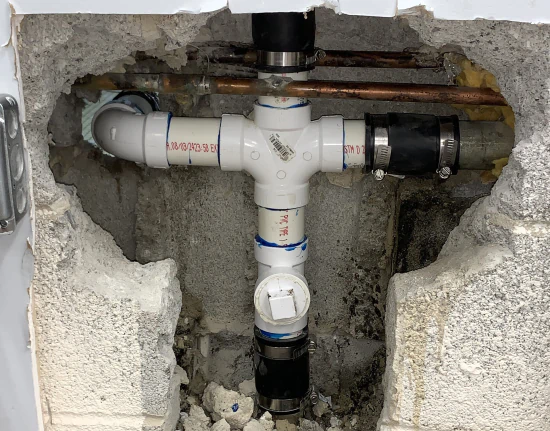
Where old cast iron meets new PVC
Drain repairs in older houses often mean joining new pipe to old. When a section of cast iron has rusted through or cracked, we cut it out and tie new PVC into the sound cast iron on each side with banded couplings. Each one is a rubber sleeve with a stainless steel band clamped around it, which holds two different pipe materials in line and keeps the joint sealed.
If the wall is already open and the drain has no handy cleanout, we add one while the pipe is exposed. It gives the next plumber a way to clear a clog without cutting the wall again. On supply lines, we cut back to solid pipe and make the new joints with fittings that match what is already there.
How we keep the opening small:
- Pinpoint the leak first, so the first cut is the right one
- Cut a clean, square opening that patches easily
- Cover floors and furniture below and around the work
- Leave an access panel where a shutoff or cleanout will need reaching again
A section repair or a repipe, called honestly
Most leaks need one repair and nothing more. If the rest of the pipe is in good shape and a single fitting or section failed, we replace that piece and you are done. We always lay out the smaller repair first, and nothing gets cut until you say go.
The honest answer changes when the pipe itself is the problem. Copper that has already pinholed in more than one place is thin along its whole length. Galvanized that is rusting at one joint is rusting at all of them. Polybutylene, which we replace often and know well, does not get better with patches. In those houses we show you what we found, explain why a larger replacement may serve you better, and let you decide.
Pressure test, run water, then close up
Before any wall goes back together, we test the work. Supply repairs are pressure tested with the joint in plain view. Drain repairs get water run through them from the fixtures above while we watch the new couplings. Only when nothing weeps do we close the opening, and we clean up the dust and debris before we leave.
The plumber behind the repair
Jackson Plumbing is a licensed Master Plumber, license PLM40000116, with WSSC credential P-83640, Maryland license 109495 and Virginia license 2710083375. We hold ASSE certification and a BBB A-rating. Brandon has been at this nearly three decades, starting at sixteen next to his uncle in New York, and he explains what he finds in plain terms.
Our main pipe repair page covers this work across the DMV. When a repair is part of a bigger project, our bathroom plumbing in Hyattsville handles drain and supply work while the floor is open. Tell us where the water is showing up and we will get back to you.
Leaks in Hyattsville, answered from Suitland
Our shop is in Suitland, and Hyattsville is part of our regular Prince George's County service area. Water spreads the longer it runs, so the phone is answered 24/7 and you get a real arrival time.
Book a free quoteIn customers’ own words
He is a man of his word. He shows up when he says he is coming and he cleans up behind himself.
T. T.Google ReviewsBrandon Jackson is one of the best plumbers I have ever met. He is professional, honest…
Celestine RobinsonGoogle ReviewsTheir service was prompt, professional, and reliable. The pricing was fair, with no hidden fees.
Wesline ReynaGoogle ReviewsBrandon was extremely knowledgeable and professional from the moment he arrived.
M. Owens JonesGoogle ReviewsPipe repair questions from Hyattsville homeowners
How do you find a leak without opening a lot of wall?
We narrow it down first: whether it is supply or drain water, which fixture makes it worse, whether the meter moves with everything off. Then we follow the pipe routes and check the fixtures above the stain. The goal is a single opening, cut in the right place the first time.
What causes pinhole leaks in copper pipe?
Copper slowly wears from the inside over decades, especially where water moves fast or the water is hard on the metal. The wall thins until a tiny hole opens. One pinhole is a repair. Several along the same run usually mean the whole length is thin and due for replacement.
Do you replace polybutylene pipe?
Yes, it is one of our specialties. Polybutylene is the gray plastic supply pipe found in some older homes, and it tends to crack and fail without warning. When we find it during a repair, we show you where it runs in the house and explain your options for replacing it.
Can old cast iron be connected to new PVC?
Yes. We cut the failed cast iron back to sound pipe and join new PVC to it with banded couplings, which clamp a stainless band around a rubber sleeve to hold the joint tight and in line. While the wall is open, we often add a cleanout for easier access later.
When is a repipe the better choice?
When the pipe itself is failing instead of one fitting. Several pinholes in copper, rust at many galvanized joints, or polybutylene throughout the house all point that way. We always offer the smaller repair first and explain why a larger replacement might make sense, and then you decide.
Do you test the repair before closing the wall?
Always. Supply repairs are pressure tested with the joint in view, and drain repairs get water run through them from the fixtures above while we watch the new fittings. The opening only gets closed once nothing weeps, and we clean up the work area before we leave.
Can you come out at night for a burst pipe in Hyattsville?
Yes. We answer 24/7, and a real person picks up. Shut off the main valve if you can find it, then call (202) 840-1998. Hyattsville is inside our regular Prince George’s County service area, a short trip from our shop in Suitland.
Water where it shouldn’t be?
Tell us where the stain is and what makes it worse. We will find the source, price the repair before we start, and leave the room clean, any hour of the day.