


Gas Line Installation for Lanham
A new range, a gas dryer, a water heater swap, a standby generator or a grill on the patio all start with one question: can the piping carry it? We size the line for everything on it, run it in black iron or CSST, put a shutoff at the appliance, and test the whole run before gas ever reaches it.
Sizing the pipe for everything it feeds
Every gas appliance carries a rating for how much fuel it burns, and the pipe feeding it can only deliver so much over a given distance. Add a big appliance to piping that was sized years ago for a furnace and a water heater, and something goes short. The burners on the range drop low and turn lazy when the furnace kicks on, or a new tankless water heater throws an error halfway through a shower.
So before we run anything, we add up the load: every appliance already on the system plus the new one, and the length of pipe from the meter to the farthest of them. That tells us whether the existing line can take a new branch or whether a larger trunk is needed. If the total load grows a great deal, the gas utility may also need to look at the meter.
- Gas ranges and cooktops, including a switch from electric
- Gas dryers in a laundry room or basement
- Water heaters, tank and tankless
- Standby generators and outdoor grills
Start with the appliance you picked
Have the model number or spec sheet handy if you can. The rating on the data plate decides the pipe size, the connector and sometimes where the line has to come up through the floor. A tankless water heater surprises people most, because it can draw far more gas than the tank it replaces, often more than the furnace.
The DMV-wide gas line installation page has more on this work, and gas line repair handles leaks on piping you already have. Swapping the heater too? Read about water heater installation. Finished installs are in our project gallery, and you can request a free quote online.
Black iron or flexible CSST
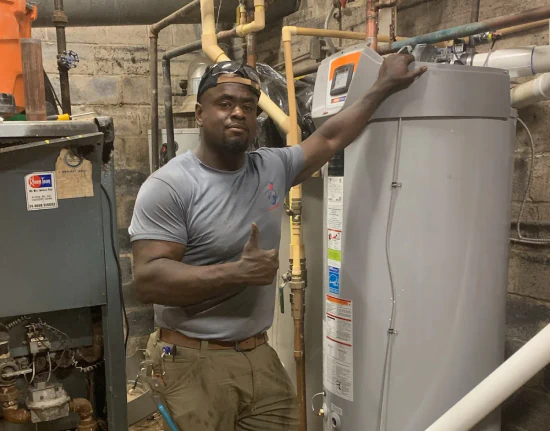
Black iron is threaded steel pipe. It is rigid and it lasts, and every fitting is cut and threaded on site, which makes it slower to work through finished space. It suits piping that runs exposed in a basement or mechanical room, like the one in this photo, where Brandon stands beside a newly installed gas water heater.
CSST, the corrugated stainless steel tubing with a colored jacket, bends around joists and through walls in long runs with very few joints, which makes it practical in a finished house. It comes with one requirement people should hear plainly: it has to be bonded to the home's electrical grounding system. A nearby lightning strike can send current along the tubing, and bonding gives that current a safer path than arcing through the thin wall. We never leave CSST unbonded.
- A shutoff valve within reach of every appliance
- A sediment trap ahead of appliances that call for one
- New connectors, never a reused old one
- Pipe rated for burial on outdoor runs
Permit, pressure test, then gas
New gas piping is permitted work. We pull the permit where one is required, and the installation is inspected before it goes into service. Before any appliance is hooked up, the new piping is capped and held under air pressure on a gauge for a set period. If the needle drops, there is a leak somewhere, and we find it while every joint is still in plain view.
Once the test holds and the inspection is signed off, the line is opened, air is purged out of the new pipe, and each appliance is lit and checked. Every joint we made gets checked a second time with gas in it. Then we walk you to each shutoff and show you how to close it.
Ranges, dryers, generators and grills
Each appliance brings its own details. A range usually needs a short stub behind it and a flexible connector long enough to pull the range out for cleaning. A dryer needs its shutoff where you can reach it without dragging the machine across the room. A standby generator sits outside, often a long way from the meter, so pipe size matters even more there. The transfer switch and wiring belong to an electrician, and our part is the gas supply to the unit. A grill on a deck or patio gets its own valve and a quick-disconnect so it can be rolled away.
If you smell gas
Leave first. Get everyone out of the building without flipping light switches, unplugging anything or lighting a flame, and leave the door open behind you. From outside, well away from the house, call your gas utility's emergency line or 911. They make the situation safe and shut off the supply if they need to.
Once the utility has done that, call us at (202) 840-1998, day or night. We track down the leak, repair it, and pressure test the piping again before gas is turned back on.
Gas piping for Lanham homes and businesses
Route 450 runs through Lanham beside New Carrollton, and both are part of our regular Prince George's County service area. Residential and commercial gas work gets the same licensed Master Plumber and a clear price up front.
Describe your projectIn the words of Brandon's customers
Brandon Jackson is one of the best plumbers I have ever met. He is professional, honest…
Celestine RobinsonGoogle ReviewsHe is a man of his word. He shows up when he says he is coming and he cleans up behind himself.
T. T.Google ReviewsBrandon was extremely knowledgeable and professional from the moment he arrived.
M. Owens JonesGoogle ReviewsTheir service was prompt, professional, and reliable. The pricing was fair, with no hidden fees.
Wesline ReynaGoogle ReviewsGas line questions from Lanham
Can you add a gas line for a new range or dryer?
Yes. We check whether the existing piping has the capacity, then run a new branch to the appliance with its own shutoff valve and a proper connector. If there is no gas near the spot you want, we work out the shortest safe route from the nearest line that can carry the load.
Black iron or CSST: which do you use?
Both, depending on the route. Black iron suits exposed runs in basements and mechanical rooms. CSST suits long runs through finished walls and ceilings. Whenever CSST goes in, it is bonded to the electrical grounding system, a requirement many people never hear about until something goes wrong.
Do I need a permit for a new gas line?
New gas piping generally needs a permit and an inspection, and we handle both where they apply. The piping is also pressure tested before any appliance is connected, so a leak shows up on the gauge long before there is gas in the line.
Can my existing line handle a tankless water heater or a generator?
Sometimes, but often it cannot. Both draw a lot of gas, and piping sized years ago for a furnace and a tank water heater may come up short. We add up every appliance on the system and the length of the run, then tell you whether a larger line is needed.
What should I do if I smell gas?
Get everyone outside without using switches, phones or flames indoors. From a safe distance, call your gas utility's emergency number or 911. After the utility has made it safe, call us at (202) 840-1998 and we will find and repair the leak.
Do you run gas lines for businesses too?
Yes. We install gas piping for commercial kitchens, shops and other business spaces as well as homes, sized for the equipment being connected. Work can be planned to keep the space open as much as possible while the new line goes in.
Who does the gas work, and what licenses does he hold?
Brandon Jackson is a licensed Master Plumber, license PLM40000116, and has spent nearly three decades in the trade. In Maryland the license number is 109495, in Virginia it is 2710083375, and the WSSC credential is P-83640. ASSE certification and an A rating from the BBB round it out.
Adding gas to a kitchen, laundry or yard?
Tell us at (202) 840-1998 which appliances you want on gas. You get a sized plan and a free quote before any pipe is cut, and nothing is lit until the new line holds its test.