

Hydro Jetting for Lanham Drains
Some drains clear for a week after cabling and then slow right back down. Grease, scale and roots coat the whole pipe wall, and a cable only punches a hole through the middle. Hydro jetting scours the wall itself, once a camera has shown us the pipe is sound enough to take it.
When a cable is no longer enough
A drain cable is the right first tool for most clogs. It spins through a wad of hair or a lost toy and opens the line in minutes. Where it falls short is buildup that lines the pipe from wall to wall. Kitchen grease hardens into a ring, hard-water scale narrows old pipe, and fine roots work in through a joint and spread into a mat. The cable bores a path through the middle, water runs again, and the rest of the buildup stays put, waiting for the next pan of bacon fat.
That is the pattern that sends people looking for jetting: the same drain backing up every few months, a kitchen line slowing again a week after it was cleared, a main drain that gurgles whenever the washer empties.
- A kitchen sink that needs clearing more than twice a year
- A basement floor drain or lowest fixture that backs up first
- Gurgling at a toilet or tub when another fixture drains
- A restaurant or shop line that slows down on a predictable cycle
Jetting or cabling, decided at the drain
We do not sell jetting to every caller. If one pass with a cable and a look with the camera show a clean, healthy line, that is where the job ends. When the camera shows grease, scale or roots lining the pipe, jetting is the better use of your money, and we tell you so with a price before anything starts. No hidden fees show up after the work.
Our main hydro jetting page covers this work across the DMV, and drain camera inspection explains the look we take first. To see cleanouts and drain work up close, browse the project gallery, or ask for a free quote.
Getting into the line through a cleanout
A jetter hose goes in where a cable does, through a cleanout: a capped opening built into the drain so it can be reached without pulling a toilet or climbing to a roof vent. Plenty of older homes and buildings either have no cleanout where one is needed, or have one buried behind a finished wall, painted shut or rusted solid.
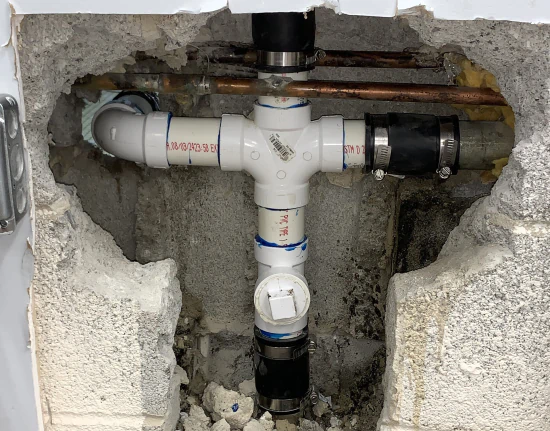
In that case we cut a new one in. The photo shows that kind of job: an old drain line inside a block wall, opened up, with a new white PVC cleanout fitting spliced in and closed with a square plug. With a proper opening in place, the next cleaning starts at the plug instead of with demolition.
- An opening sized for the hose and the camera head
- Placed where the line actually needs cleaning
- Capped with a removable plug for the next visit
- Checked for leaks once the splice is made
A camera look before any water goes in
Jetting puts a lot of force into a pipe. On a sound line that force does nothing but clean. On a line with a cracked hub, a sagging section full of standing water or a joint that has pulled apart, the same force can push water into the soil, wash out the bedding under the pipe, or snag the nozzle on a broken edge. So the camera goes in first.
You are welcome to watch the screen with us. We show you where the buildup is, how far down the line it runs, and whether there is anything we would not put a jetter through. If the camera finds a break, jetting waits, and the conversation turns to repairing that section first.
Old cast iron, and when jetting is the wrong tool
Cast iron drains in older houses rust from the inside. Scale builds up in ridges along the bottom and catches everything that passes. A jetter fitted with the right nozzle can strip much of that scale away and give the pipe back most of its opening, and that alone can buy an old line years of service.
It has limits. When the bottom of a cast iron pipe has rusted thin or worn into a channel, there may not be enough metal left to clean hard, and cleaning it can expose holes the scale was plugging. Roots work the same way. A cutting nozzle clears them, but they came in through an opening in a joint and they will grow back through it. In both cases we jet to restore flow, then tell you plainly that the lasting fix is a repair or a new section of pipe.
Kitchen grease, restaurant lines and the main
Grease is the most common reason we jet. At home it comes from years of pans rinsed in the sink, and it collects where the kitchen line turns or levels out under the floor. In a restaurant or any business with a commercial kitchen, the volume is far higher, and the line between the kitchen and the grease trap can close up on a schedule you could set a calendar by.
A home's main drain is the other big one. When every fixture in the house runs slow, or the lowest drain backs up first, the main is usually carrying the problem. Jetting it from a cleanout near the point where it leaves the building clears the whole run in one pass.
Camera and jetter, a short run from Suitland
Lanham sits next to New Carrollton along Route 450, inside the part of Prince George's County we cover every day from our Suitland shop. Homes and businesses here get the same camera-first approach and a firm price before work begins.
Tell us about the drainWhat Brandon's customers have said
Brandon Jackson is one of the best plumbers I have ever met. He is professional, honest…
Celestine RobinsonGoogle ReviewsHe is a man of his word. He shows up when he says he is coming and he cleans up behind himself.
T. T.Google ReviewsBrandon was extremely knowledgeable and professional from the moment he arrived.
M. Owens JonesGoogle ReviewsTheir service was prompt, professional, and reliable. The pricing was fair, with no hidden fees.
Wesline ReynaGoogle ReviewsHydro jetting questions from Lanham
Is hydro jetting safe for older pipes?
Often, though not always, which is why the camera goes in first. Sound cast iron, clay and PVC handle jetting well. Pipe that is cracked, rusted thin or separated at a joint may not, and we tell you before any jetting starts if your line falls into that group.
How is jetting different from snaking a drain?
A snake, or cable, bores a path through a clog. A jetter sends water through a nozzle that sprays against the pipe wall as it travels, so it washes away the grease, scale or roots lining the whole pipe. For a simple blockage, a cable is usually enough.
Will roots come back after jetting?
Usually, given time. Jetting cuts the roots out of the pipe, but they got in through a crack or a loose joint, and that opening is still there. Clearing them restores flow. Repairing or replacing the damaged section is what keeps them out for good.
Do you jet commercial kitchen and restaurant lines?
Yes. Grease lines from commercial kitchens are some of the lines we jet most often, along with floor drains and building mains. We can schedule the work around your hours so the kitchen is not shut down in the middle of a busy service.
What if my drain line has no cleanout?
Then we can usually add one. A new cleanout gets cut into the drain where the line needs cleaning and closed with a removable plug. It saves time on every future visit, and it means the next clog can be reached without pulling a toilet or opening a wall.
How do I keep a line clear after it is jetted?
Keep grease, oil and food scraps out of the sink, wipe pans before washing them, and use strainers in every sink. Businesses with commercial kitchens usually do best with cleaning on a set cycle, timed to how quickly their line builds up again.
Who does the work, and is it licensed?
Brandon Jackson, a licensed Master Plumber, license PLM40000116, with nearly three decades in the trade. Jackson Plumbing also holds Maryland license 109495, Virginia license 2710083375 and WSSC credential P-83640, carries ASSE certification and has an A rating from the BBB.
A drain that keeps coming back?
Call (202) 840-1998 any hour and describe what the drain is doing. A camera look comes before the free quote, and the quote comes before any cleaning.